Walking with Jesus Through Creation: A Visio Divina Journey
Sometimes the shortest walks become the longest journeys...
Prelude: An Invitation to Walk
There are moments in life when we unknowingly stand at the beginning of something that will quietly change us. They rarely announce themselves with great significance. Instead, they begin with a simple invitation, an ordinary decision, or a seemingly unremarkable step in a new direction. Yesterday became one of those moments for me.
Our St. John's Anglican Church Bible study group gathered for our annual summer social at R Farm, a beautiful nature preserve just outside Bowmanville, Ontario. Surrounded by forests, winding trails, flowing streams, and open fields, it was the kind of place where the noise of everyday life seemed to fade into the background. Before sharing anything else, I want to express my heartfelt gratitude to Julia Smith for so generously welcoming us onto this property. It is a place that reflects a deep appreciation for God's creation, and I feel privileged that we were invited to spend our day there.
Rather than gathering around tables with our study books open, we were invited into something entirely different. Each of us was encouraged to walk alone through the property, carrying only a simple invitation: ask Jesus to walk beside us and practice Visio Divina, or "divine seeing." The exercise is not about searching for hidden messages or extraordinary signs. Instead, it is about slowing down enough to notice what God may already be revealing through His creation. We would later return to the camp and share what we had experienced, but first we would each spend time alone with Christ in the quiet of the forest.
As I stood at the trailhead, I realized that I had no expectations for what might happen. I wasn't hoping for some dramatic spiritual experience, nor was I expecting profound revelations. I simply paused, took a deep breath, and offered a very short prayer.
"Jesus, would You walk with me today?"
The prayer lasted only a few seconds, but as I reflect on it now, I think it became the most important part of the entire afternoon.
I have prayed countless times throughout my life. Like many Christians, my prayers often begin with requests. I pray for family and friends, for guidance, for wisdom, for healing, for opportunities, and for strength to face whatever lies ahead. There is nothing wrong with those prayers. Scripture repeatedly encourages us to bring every concern before God. Yet this prayer felt noticeably different because I wasn't asking Jesus to do anything.
I wasn't asking Him to solve a problem.
I wasn't asking Him to answer a difficult question.
I wasn't asking Him to change my circumstances.
I was simply inviting Him to be with me.
As I took my first steps along the trail, another thought quietly entered my mind, and it stayed with me for much of the afternoon.
Why don't I do this more often?
Why had it never occurred to me to invite Jesus to walk with me when I'm simply walking to the grocery store? Why do I naturally think to invite Him into Bible studies, Sunday worship, or a peaceful walk through the forest, yet rarely think to invite Him into the ordinary routines that make up most of my life?
What would happen if I asked Him to walk with me while running errands?
What would change if I consciously invited Him into my daily commute?
What conversations might unfold if I remembered His presence while standing in line at the checkout or walking through a crowded parking lot?
The more I thought about it, the more I realized that I had unintentionally divided my life into "spiritual moments" and "ordinary moments." Somewhere along the way, I had begun treating prayer as something reserved for church services, quiet devotional time, or intentionally spiritual experiences. Yet when I considered the life of Jesus, I realized He never made that distinction.
Jesus spent remarkably little time inside synagogues compared to the amount of time He spent simply walking with people. Much of His ministry unfolded on dusty roads between villages, beside lakes, on mountainsides, around dinner tables, through vineyards, and in fishing boats. He pointed to birds flying overhead, flowers blooming in fields, seeds falling into soil, shepherds caring for sheep, fishermen casting their nets, and trees producing fruit. He consistently used ordinary moments and ordinary places to reveal extraordinary truths about the Kingdom of God.
Perhaps that is one of the reasons creation has always held such an important place within the Christian life. It is not because God is somehow more present in the forest than He is in the middle of a city. God is equally present everywhere. The difference lies not in His presence but in our awareness of it.
The forest has a remarkable ability to remove many of the distractions that constantly compete for our attention. Emails stop arriving. Notifications become silent. Deadlines lose their urgency. Instead of hearing traffic, we hear birdsong. Instead of fluorescent lights, we notice sunlight filtering through leaves. Instead of advertisements competing for our attention, we become aware of the intricate beauty that has existed long before we arrived.
Creation does not create God's presence.
It creates space for us to notice it.
As I walked deeper beneath the trees, I began to understand that this afternoon was not about escaping the world for a few hours. The purpose was not simply to find peace in nature before returning to ordinary life. Instead, I sensed that God was gently teaching me a different way of seeing.
Perhaps the goal of walking with Jesus through the forest is not merely to experience Him in creation. Perhaps it is to learn how to recognize His presence everywhere else once we leave it.
I could not have imagined where that simple prayer would lead me.
I had no idea that the trail would become a journey through childhood memories, reflections on my grandfather, thoughts of my father, gratitude for friends, questions about suffering, discoveries about God's quiet provision, and a renewed appreciation for the beauty of creation.
All I knew was that I had invited Jesus to walk with me.
Looking back now, I realize He had been waiting for the invitation all along.
Why We Left the Camp
There is something beautifully symbolic about the way our afternoon began.
We did not remain gathered around the gazebo or camp. We did not stay where conversation was comfortable, where laughter came easily, or where it would have been simple to continue enjoying one another's company. Instead, we were each invited to leave the camp and walk into the forest, fields or riverside alone.
At first, that seemed almost counterintuitive.
After all, we had gathered together as a Bible study group. We had come to enjoy fellowship, to strengthen friendships, and to spend time with one another. Yet one of the most meaningful parts of the day required us to separate, to embrace silence, and to become comfortable with our own company.
The more I reflected on it, the more I realized that this pattern appears throughout Scripture.
Again and again, we find people meeting God after stepping away from the crowds.
Moses encountered God in the wilderness.
Elijah heard God's voice not in the wind, the earthquake, or the fire, but in the gentle whisper that followed.
David spent countless hours alone in fields long before he became king, learning to recognize God's presence while tending sheep.
Jesus Himself regularly withdrew from the crowds to lonely places to pray, even in the midst of His public ministry.
The pattern is difficult to ignore.
Community is where we are encouraged.
Solitude is often where we are transformed.
That doesn't mean one is more important than the other. We need both. The Church has always understood this rhythm. We gather together to worship, learn, and support one another, but we also need moments where our faith is no longer carried by the voices around us. There comes a point when we must learn to walk with Christ ourselves.
As I entered the trail, I noticed something unexpected.
The silence was not empty.
It was alive.
The forest was filled with sounds I rarely notice in everyday life. Birds called to one another across the trees. Leaves gently rustled as the wind moved through the canopy above. Insects hummed quietly in the background. Somewhere in the distance, I could hear water flowing over rocks.
None of these sounds demanded my attention.
They simply existed.
I couldn't help but compare that to the world I had left behind.
Modern life seems designed to compete for every available moment of our attention. Phones vibrate. Emails arrive. News headlines demand immediate reactions. Advertisements tell us what we are missing. Social media invites us to compare ourselves with everyone else. Even when we aren't actively doing anything, our minds often remain occupied by what still needs to be done.
We have become remarkably skilled at filling every moment of silence.
Perhaps that is why silence can feel so uncomfortable.
When external noise disappears, we begin hearing the internal noise we have been carrying all along.
At first, my mind did exactly what I expected it to do.
I thought about work.
I thought about projects waiting to be finished.
I thought about responsibilities at church.
I thought about upcoming meetings.
I thought about things I should remember to do when I got home.
It took time before those thoughts began to loosen their grip.
The forest never hurried me.
There was no expectation that I reach a particular destination by a certain time except to be back to the gazebo by 3:00PM. There was no checklist to complete and no conversation I needed to keep up with. My only task was to walk with Jesus and pay attention.
That sounds remarkably simple.
In practice, it was surprisingly difficult.
I began to realize how accustomed I have become to productivity. Even while walking, part of me wanted to accomplish something. I wanted insights. I wanted profound thoughts. I wanted a meaningful spiritual experience that I could later share with the group.
Then another realization quietly emerged.
Perhaps I was still trying to control the experience.
Perhaps God wasn't asking me to find anything at all.
Perhaps He was simply inviting me to notice.
There is a profound difference between searching and noticing.
Searching assumes that something is missing.
Noticing assumes that something is already present.
That thought changed the way I walked.
Instead of asking, "Lord, what are You trying to show me?" I found myself asking, "Lord, what have You already been showing me that I've been too busy to see?"
The forest became less like a destination and more like a teacher.
Every step invited me to slow down.
Every breath reminded me that I didn't need to rush.
Every tree seemed content simply to stand where God had planted it.
I wondered when I had become so uncomfortable with simply being present.
The more I slowed down, the more I became aware that creation has no anxiety about proving its worth.
The trees do not compete with one another.
The moss does not wish it were a towering pine.
The river does not apologize for flowing at its own pace.
Everything simply fulfills the purpose for which it was created.
As human beings, we often struggle to do the same.
We compare.
We measure.
We hurry.
We worry that we are behind.
We wonder if we are enough.
Yet standing in that forest, none of those questions seemed important.
Creation wasn't asking me to become someone else.
It was quietly inviting me to become fully present as the person God had already created me to be.
Perhaps leaving the camp was never really about walking into the forest.
Perhaps it was about walking away, if only for a little while, from all the voices that tell us who we should be, so that we can once again hear the One who simply calls us by name.
Walking into the Forest: Seeing Through My Grandfather's Eyes
As the trail gently disappeared beneath the trees, I found myself slowing down without even realizing it.
The path wasn't difficult. There was no steep climb or challenging terrain demanding my attention. Instead, the forest itself seemed to invite a different pace. My footsteps became quieter. My breathing became steadier. The noise I had carried with me from everyday life slowly began to fade, replaced by the gentle rhythm of creation carrying on exactly as it had long before I arrived.
The further I walked, the more my senses awakened.
I noticed sunlight dancing across leaves high above me, creating shifting patterns on the forest floor that changed every time the wind stirred the branches. I heard birds calling to one another from places I couldn't see, their songs echoing through the trees in ways that seemed almost conversational. The scent of pine, cedar, damp earth, and wildflowers filled the air. Every now and then, a cool breeze would find its way through the canopy, bringing with it the unmistakable freshness that only a healthy forest seems able to produce.
I wasn't simply observing the forest.
I was becoming part of it.
It was somewhere during those first few minutes that my thoughts unexpectedly turned to my grandfather, Grandpa Lundgren.
I smiled almost immediately and developed a quick happy tear, first in the left eye as usual then the right.
I hadn't consciously thought about him before beginning the walk, yet suddenly he was there in my memories as vividly as if he had been walking a few steps ahead of me. I remembered the times we had spent outdoors together, the quiet moments that didn't seem particularly important when I was younger, and the way he seemed completely at home in places like this.
As a child, I never really understood why he loved nature so deeply.
To me, it was just a forest.
Trees were trees.
Birds were birds.
Streams were simply streams.
I appreciated that it was beautiful, but I don't think I ever understood why someone could spend hours wandering through the woods without becoming bored.
Yesterday, for the very first time, I think I finally understood.
Nature isn't simply something we look at.
It's something we enter.
When we allow ourselves to slow down, creation quietly changes us. It gently peels away the layers of distraction we've accumulated, inviting us to notice things that have been there all along. It reminds us that beauty often whispers instead of shouting, and that some of life's greatest lessons refuse to be rushed.
Standing there among the trees, I wondered how many times my grandfather had experienced exactly what I was experiencing.
How many times had he stood quietly, listening to the wind?
How many times had he found peace simply by watching sunlight filter through the branches?
How many times had he walked without needing a destination?
I wish I had asked him.
There are so many questions we think we'll have time to ask someday.
Then one day we realize that "someday" has quietly become yesterday.
I found myself wishing I could walk this trail with him one more time, not because I needed him to explain the forest, but because I finally understood what he had been trying to show me all those years ago.
Perhaps some lessons can only be learned when we are ready to receive them.
As children, we often admire the enthusiasm of those who love nature without truly understanding it. We enjoy the picnic, the fishing trip, or the afternoon walk because we are spending time with someone we love. Years later, we return to those same places carrying the weight of adulthood, and suddenly we discover that the place itself has something to teach us.
The forest hadn't changed.
I had.
That realization stayed with me for the rest of the afternoon.
It also made me think about how often God patiently waits for us to grow into understanding.
There are truths we hear for years before we truly comprehend them. We read familiar passages of Scripture that suddenly speak with fresh clarity because our lives have changed. We remember conversations with parents, grandparents, teachers, or friends and realize they were planting seeds that would not bear fruit until much later.
Perhaps wisdom is less about discovering something entirely new and more about finally seeing what has always been there.
As I continued walking, I silently thanked God for my grandfather.
Not simply for the memories we shared, but for the gift he had unknowingly given me. His love for creation had become part of my own story, even if it had taken decades for me to recognize it. In that moment, I realized that one of the greatest legacies we leave behind isn't found in possessions or accomplishments. It is found in the loves we quietly pass on to others.
My grandfather taught me to love the outdoors long before I understood why it mattered.
Yesterday, Jesus helped me understand.
For the first time, I wasn't just walking through a forest.
I was seeing it through my grandfather's eyes.
And perhaps, just a little more, through the eyes of the One who first imagined every tree, every bird, every stream, and every ray of sunlight that surrounded me.
The Trail, the Bends, the River, the Moss, and God's Provision
The deeper I wandered into the forest, the more I realized that I had stopped thinking about reaching a destination.
The trail itself had become the destination.
That may sound obvious, but it struck me how often I live my life with my eyes fixed on where I am trying to get rather than where I actually am. We become so focused on the next promotion, the next project, the next holiday, the next stage of life, or the next problem to solve that we miss the beauty of the path we are currently walking.
The forest refused to let me rush.
Every few hundred metres the trail would bend and disappear from view. I could never see very far ahead. Each corner concealed whatever came next, requiring me to simply trust the path beneath my feet.
It occurred to me that this is exactly how life feels.
There have been countless times when I have desperately wanted to know what lies around the next bend. During periods of unemployment, I wanted to know where my next opportunity would come from. During seasons of grief, I wanted to know when the pain would become lighter. During moments of uncertainty, I wanted reassurance that everything would eventually work out.
Instead, God has usually given me something much simpler.
The next step.
As I reflected on this, I wondered whether that was enough because, if I'm honest, it often doesn't feel like it. I want the map. I want the destination. I want to know where the trail ends before I commit myself to following it.
Faith rarely works that way.
The trail before me reminded me that trust isn't built by seeing the entire journey. It is built by faithfully taking one step after another, even when the next bend hides everything beyond it.
I also noticed that every bend carried a quiet invitation.
As children, we often race around corners because we cannot wait to discover what lies beyond them. Somewhere in adulthood, curiosity is gradually replaced by caution. We begin fearing what we cannot see instead of wondering what beauty might be waiting just beyond our view.
How different would my life look if I approached the unknown with more childlike curiosity and less anxious certainty?
Every bend in the forest reminded me that God has already seen what I cannot.
The path may disappear from my sight, but it never disappears from His.
Eventually, the trail brought me to a river.
It wasn't especially wide, but it immediately captured my attention. The water flowed gently around rocks that had undoubtedly rested there for years, perhaps centuries. Sunlight reflected from its surface, creating tiny flashes of light that danced with every ripple.
For several moments I simply stood and watched.
Then my attention shifted from the beauty of the river to a practical question.
How would I get across?
That question lingered longer than I expected.
There wasn't a bridge.
There wasn't an obvious crossing.
At first glance, the river appeared to present an obstacle.
Then I slowed down.
As my eyes wandered further upstream, I noticed something that I had completely missed only moments before.
A fallen tree stretched from one bank to the other.
It wasn't perfectly straight.
It wasn't smooth.
It certainly wasn't a bridge designed by an engineer.
Yet it was exactly what was needed.
Standing there, I couldn't help but smile.
The tree had not suddenly appeared because I needed it.
It had been there all along.
The only thing that changed was my willingness to stop looking at the obstacle long enough to notice God's provision.
I wondered how many times I have done exactly the opposite in my own life.
How often have I become so consumed by the river in front of me that I never noticed the fallen tree lying quietly nearby?
How many times has God already prepared a way while I remained convinced that no way existed?
His provision doesn't always look the way I expect.
Sometimes it is dramatic.
More often, it is wonderfully ordinary.
A conversation.
A friend.
An unexpected opportunity.
A new perspective.
The quiet encouragement of Scripture at exactly the right moment.
Or simply enough grace to take the next step without yet knowing the one after that.
The forest seemed to whisper a gentle reminder.
God often provides before we recognize our need.
As I continued walking, another part of creation repeatedly drew my attention.
It wasn't the towering trees.
It wasn't the flowing river.
It wasn't even the birds overhead.
It was the moss.
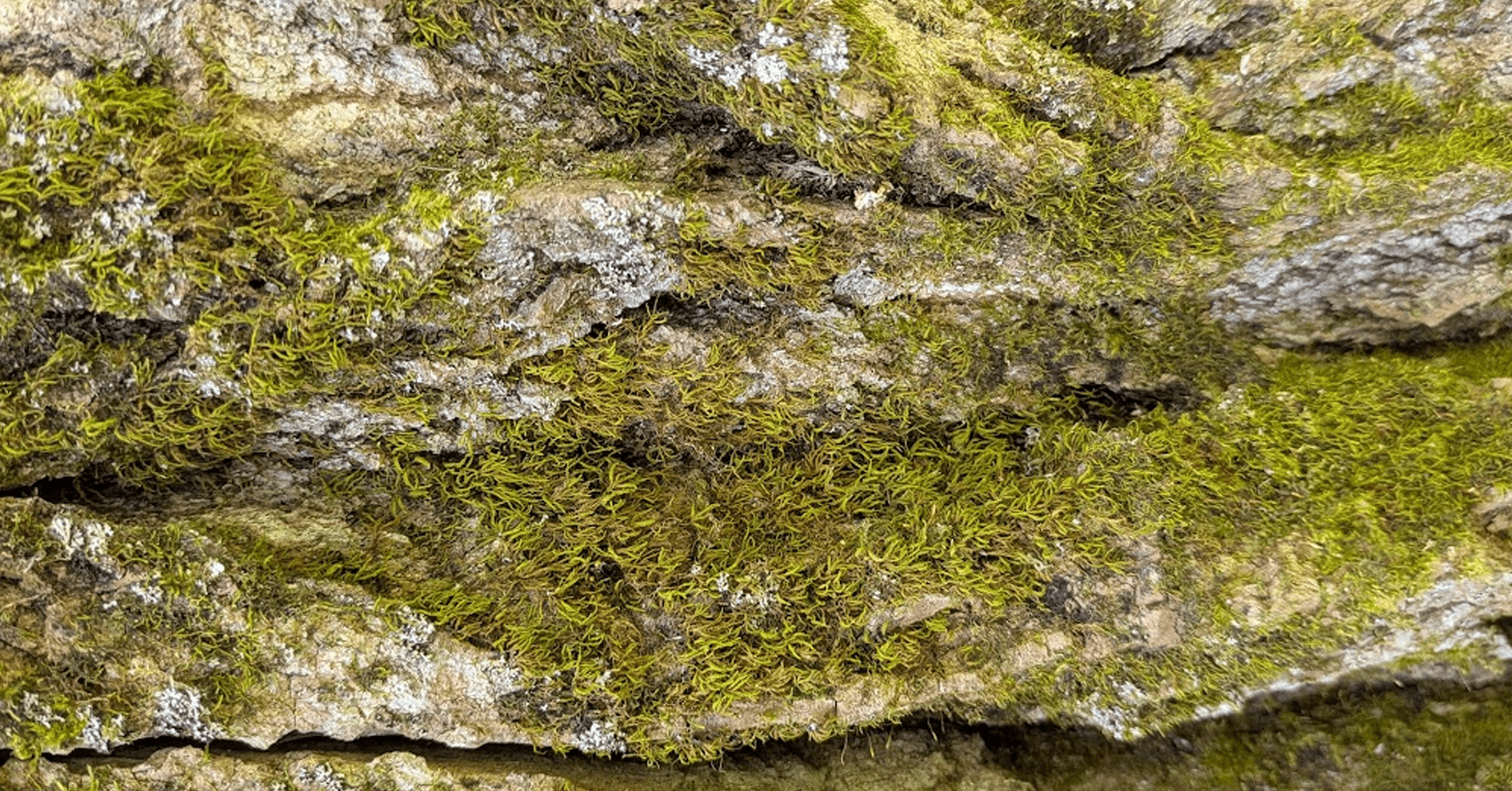
I found myself stopping over and over again to look at it.
It covered a fallen tree trunk that otherwise appeared lifeless. It wrapped itself around the fallen log, softening rough edges that had been shaped by years of weather. It spread quietly across the forest floor without drawing attention to itself, transforming places that many people would simply walk past without a second glance.
The more I observed it, the more fascinated I became.
Moss does not grow quickly.
It doesn't compete with the tallest trees.
It doesn't demand recognition.
It simply grows patiently, faithfully, almost unnoticed, and yet within it a complete ecosystem on a macro scale.
Yet without it, the forest would somehow feel incomplete.
I couldn't help but wonder whether God's work in our lives often resembles moss more than mighty oaks.
We often pray for dramatic transformation.
We ask God to change us overnight.
We long for breakthrough moments that instantly reshape our lives.
Yet looking back over my own journey, I realized that God has rarely worked that way.
More often, He has transformed me slowly.
Patiently.
Almost imperceptibly.
The changes have been so gradual that I haven't noticed them from one day to the next. It is only when I stop and look back over months or years that I realize He has been quietly covering places that once felt barren with new life.
Like moss, grace often works gently.
It settles into the broken places.
It softens what has become hard.
It brings life where we once believed nothing beautiful could grow.
No one walking through the forest would mistake moss for the most impressive part of creation.
Yet without it, something essential would be missing.
Perhaps that is true of God's quiet work within us.
The moments that change us most are not always the loudest.
Sometimes they happen almost unnoticed.
A prayer whispered years ago.
A faithful friend who stayed.
A conversation that slowly changed our thinking.
A season of waiting that taught us trust.
A walk through the woods that helped us see the world differently.
As I left the river and continued along the trail, I found myself overwhelmed with gratitude.
The forest had become something far more than scenery.
It had become a living parable.
The trail reminded me that I do not need to see the entire journey before taking the next step.
The bends reminded me that uncertainty is not the absence of God's guidance.
The river reminded me that obstacles often reveal God's provision.
The fallen tree reminded me that God frequently prepares the way long before I arrive.
The moss reminded me that His greatest work is often accomplished slowly, quietly, and faithfully over time.
None of these things spoke with words.
Yet somehow, together, they proclaimed the goodness of the One who created them.